Employer-Sponsored Retirement Plans: Which One Do You Have and Are You Maximizing It?
If you’re a high earner with access to a workplace retirement plan, you already have one of the most powerful tax-saving tools available. The problem is, most people don’t fully understand what they have, how it works, or how much they’re leaving on the table by not using it the right way.
There are several types of employer-sponsored retirement plans, and which one you have depends on where you work. Let me walk you through each of them, what makes them different, and what you should be doing with yours.
Why This Should Be a Priority
For a high W-2 earner, an employer-sponsored retirement plan is one of the most straightforward ways to reduce your taxable income while building long-term wealth. These plans can shelter tens of thousands of dollars from taxes each year. And if your employer offers a match, that’s part of your compensation that you’ve already earned. Not contributing enough to capture it is one of the most common and costly mistakes I see. (Fidelity, 2026)
The plans covered in this post are the most common ones you’ll encounter as a W-2 employee: the 401(k), 403(b), 457(b), SIMPLE IRA, and SEP IRA. Each has its own rules and limits, but they all share the same core benefit: tax-advantaged growth that a regular investment account simply can’t match.
The 401(k): The Most Common Plan
If you work for a for-profit company, there’s a good chance your workplace plan is a 401(k). It’s the most widely offered employer-sponsored plan in the country and allows you to contribute a significant portion of your salary each year on a pre-tax or Roth basis. (IRS, 2026)
How It Works
You elect to contribute a percentage of your paycheck, and that money goes directly into your 401(k) before it hits your bank account. Pre-tax contributions reduce your taxable income dollar for dollar. If your plan offers a Roth 401(k) option, contributions are made after-tax but the growth and withdrawals in retirement are tax-free.
Contribution Limits for 2026 (IRS, 2026)
- Under age 50: $24,500
- Age 50–59 or 64+: $32,500 (includes $8,000 catch-up)
- Age 60–63: $35,750 (includes the enhanced $11,250 catch-up under SECURE 2.0)
The Employer Match
Many employers match a percentage of your contributions, commonly 50% or 100% up to a certain percentage of your salary. This is part of your total compensation. If you’re not contributing enough to get the full match, you’re walking away from money your employer already set aside for you.
Example: Your employer matches 100% of contributions up to 4% of your salary and you earn $150,000. Contributing at least $6,000 captures the full $6,000 match. That’s an immediate 100% return before any investment growth.
Key Considerations
- Vesting schedules: Employer contributions may not be fully yours right away. Many plans require you to stay with the company for a set number of years before the match is 100% vested.
- Investment options: 401(k) plans vary a lot in the quality of their investment lineup. If your plan has limited options or high-fee funds, that’s worth knowing and factoring into your overall strategy.
- Mega Backdoor Roth: Some 401(k) plans allow after-tax contributions beyond the standard employee limit, which can then be converted to Roth. If your plan offers this, it can unlock significant additional tax-free savings. (Link to Mega Backdoor Roth blog post)
The 403(b): Built for Nonprofits and Education
If you work for a nonprofit, public school, hospital, or religious organization, your plan is likely a 403(b). It works almost the same as a 401(k), with the same contribution limits and the same pre-tax or Roth options. The main difference is that it’s designed specifically for tax-exempt organizations. (IRS, 2026)
Key Considerations
- 15-year catch-up rule: Employees who have worked for the same qualifying organization for at least 15 years and have historically contributed below a certain average may be eligible for an additional catch-up contribution on top of the standard limit. This is unique to the 403(b). (IRS, 2026)
- Investment options: 403(b) plans have historically been tied to annuity products, which can carry higher fees. More plans now include mutual funds and ETFs, but it is worth reviewing what’s in yours.
If you’re a teacher, nurse, doctor, or work in the nonprofit sector, a 403(b) is your primary retirement savings vehicle and it deserves the same attention as any 401(k).
The 457(b): The Government Employee Plan
The 457(b) is available primarily to state and local government employees, with some nonprofits offering it as well. It has the same contribution limits as a 401(k) and 403(b), but it has two features that really set it apart. (IRS, 2026)
Key Considerations
- No 10% early withdrawal penalty: Unlike a 401(k) or IRA, the 457(b) does not impose a 10% penalty on withdrawals taken before age 59½. If you separate from your employer, you can access the funds penalty-free regardless of your age. This is a big deal for anyone planning to retire early. (IRS, 2026)
- Double contributions near retirement: In the three years before your normal retirement age under the plan, you may be eligible to contribute up to double the standard annual limit. For 2026, that could mean up to $49,000 in a single year. And because the 457(b) has its own separate contribution limit, these additional contributions do not count against your 403(b) limit. If you have access to both plans, you can potentially max out each one independently dependent on income levels.
If you’re a government employee with access to both a 457(b) and a pension, the 457(b) can be a strong supplement, especially if early retirement is part of your plan.
The SIMPLE IRA: The Small Business Plan
The SIMPLE IRA is designed for businesses with 100 or fewer employees. If you work for a smaller company that offers a retirement plan, there’s a good chance this is it. It is easier and less expensive for employers to administer than a 401(k), which is why smaller businesses tend to offer it. (IRS, 2026)
Contribution Limits for 2026 (IRS, 2026)
- Under age 50: $17,000
- Age 50+: $21,000 (includes $4,000 catch-up)
Key Considerations
- Employer match is required by law: Employers must either match employee contributions dollar for dollar up to 3% of compensation or make a flat 2% contribution for all eligible employees regardless of whether they contribute. (IRS, 2026)
- Lower contribution limits: The SIMPLE IRA cap is lower than a 401(k) or 403(b). For high earners who want to maximize tax-deferred savings, that gap matters.
- Two-year rule: Funds cannot be rolled over to a Traditional IRA or 401(k) until you have participated in the plan for at least two years. Early withdrawals within the first two years carry a 25% penalty rather than the standard 10%. (IRS, 2026)
The SEP IRA: For the Self-Employed
The SEP IRA is most commonly used by self-employed individuals and small business owners, but it is worth understanding if you are a W-2 employee with self-employment income on the side. Unlike the other plans on this list, only the employer or self-employed individual can make contributions. Employees cannot contribute their own money. (IRS, 2026)
Contribution Limits for 2026
Employer contributions can go up to 25% of eligible compensation or $72,000, whichever is less. For a self-employed individual, the calculation is slightly different based on how net self-employment income is defined. (IRS, 2026)
Key Considerations
- High contribution ceiling: The $72,000 limit makes the SEP IRA one of the highest-ceiling savings vehicles available for self-employed high earners.
- Simple to set up and maintain: There are no annual filing requirements beyond making the contribution, which makes it attractive for sole proprietors who want a low-maintenance option.
- No employee contributions allowed: If you are a W-2 employee at a company that sponsors a SEP IRA, you cannot contribute your own dollars. Only the employer funds the account.
- No Roth option: SEP IRA contributions are always pre-tax. There is no Roth version.
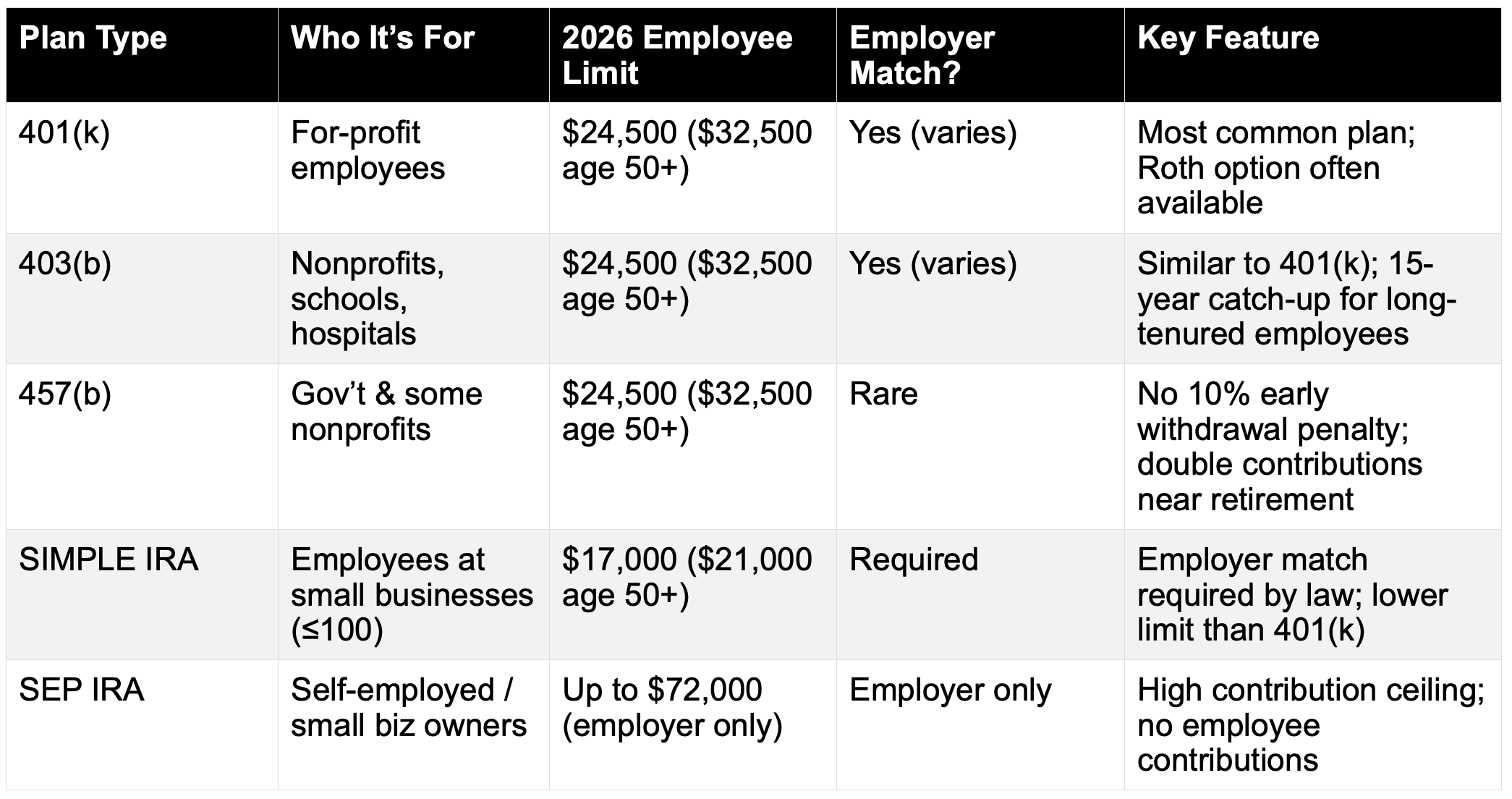
Side by Side: Which Plan Do You Have?
Here’s a quick reference for all five plans:
How to Make the Most of Whichever Plan You Have
Regardless of which plan your employer offers, the fundamentals are the same:
- At minimum, contribute enough to get the full employer match. If your employer offers one, this is always the starting point. It is part of your compensation.
- Find out if your plan has a Roth option. If it does and your tax situation supports it, building tax-free retirement income through a Roth 401(k) or Roth 403(b) is worth considering.
- Look at your investment options. Not all plans are equal. Review the funds available, their expense ratios, and whether the lineup gives you proper diversification.
- Know your vesting schedule. If you are considering a job change, understanding when employer contributions fully vest can have a real dollar impact on your timing.
- Consider maxing out. For high W-2 earners, maxing out your employer-sponsored plan is one of the most efficient ways to reduce your taxable income. Combined with an IRA, HSA, and potentially a Mega Backdoor Roth, the tax savings can be significant.
The Bottom Line
Employer-sponsored retirement plans are one of the most valuable benefits your job can offer. For high earners, they are also one of the best tax planning tools available. Whether you have a 401(k), 403(b), 457(b), SIMPLE IRA, or SEP IRA, the key is knowing what you have, understanding the rules, and using it to its full potential.
If you are not sure whether you are getting the most out of your plan or how it fits into the rest of your financial picture, that is a conversation worth having.
Have questions about your employer-sponsored plan and how to maximize it? Let’s talk!
Disclaimer: This blog post is for educational purposes only and should not be construed as personalized financial or tax advice. Retirement plan rules, contribution limits, and employer matching structures vary by plan and are subject to change based on IRS guidelines and plan documents. Vesting schedules, investment options, and plan features differ across employers. The Mega Backdoor Roth strategy depends on the specific features of your employer’s plan. Please consult with a qualified financial professional and/or tax advisor before making decisions regarding retirement plan contributions or investment strategies. All contribution limits referenced are based on 2026 IRS guidelines. A Roth IRA conversion—sometimes called a backdoor Roth strategy—is a way to contribute to a Roth IRA when income exceeds standard limits. The converted amount is treated as taxable income and may affect your tax bracket. Federal, state, and local taxes may apply. If you’re required to take a minimum distribution in the year of conversion, it must be completed before converting. To qualify for tax-free withdrawals, you must generally be age 59½ and hold the converted funds in the Roth IRA for at least five years. Each conversion has its own five-year period, and early withdrawals may be subject to a 10% penalty unless an exception applies. Income limits still apply for future direct Roth IRA contributions. As of now, the backdoor Roth IRA is still around, but no one can predict its future. If you use this backdoor Roth strategy solely to sidestep the earnings limits on Roth, you need to be aware of the risks and seek the counsel and support of a tax professional. If the IRS decides that the loophole is a violation, if restrictions do come into play at some point, they could require backdoor Roth converters to pay a penalty, or they might include a grandfather clause. This information is not intended to be a substitute for specific individualized tax advice We suggest that you discuss your specific tax issues with a qualified tax advisor. All information is believed to be from reliable sources; however, LPL Financial makes no representation as to its completeness or accuracy.